
How Artists Truly Learn
The romanticized concept of “originality” as a pure, internal wellspring is a fiction that requires urgent unravelling. Historically and practically, artistic development is never the result of isolated genius, but the relentless absorption and internalization of existing works, references, and styles. To view the artist as a “pure source” is to ignore the reality of the craft. In truth, the artist functions as a sophisticated filter a pattern recognizer who synthesizes the aesthetic data of the past into the expressions of the present.
Every artist works from reference. They study compositions, steal color palettes, and mimic the lighting of those who came before them. This internalization of a vast corpus of external data allows for the production of “new” work based on recognized patterns. The creative process is not a miracle; it is an ingestion of the library

The Reference Library of the Mind
To understand the “originality” of any work, one must confront the creator’s hidden reference library. If we demanded total transparency, an artist would be forced to reveal their internet search history, their bookshelf, and every specific reference utilized for a piece. The “original” idea is merely a construction built from this raw data. We must be honest: if influence without explicit permission were truly considered theft, every artist who has ever looked at a reference image or studied a master’s brushstroke would be labeled a thief. What is celebrated as “inspiration” is simply the human version of the same pattern recognition and recombination used by our new mechanical tools.
- The Great Master’s Factory: Behind the Workshop Door
In the 17th and 18th centuries, the “Great Masters” did not toil in solitary rooms. Figures like Rubens and Rembrandt operated sophisticated production lines. These workshops relied on a rigid division of labor where the “Master” provided the primary visionroughly 20% of the effort, encompassing the initial composition, the faces, and the final defining flourishes.
The remaining 80%, the grunt work, was delegated to an “army of journeymen and assistants.” These subordinates handled the backgrounds, the complex drapery, and the minor figures. In this system, the apprentice’s goal was not innovation, but absolute fidelity to the master’s style. For generations, success was measured by how perfectly one could reproduce a lineage of technique. The workshop was the production unit, and the output was judged on its merit, regardless of whose hand held the brush for the majority of the execution. The master’s name was the brand; the labor was a commodity.
- The Material Cost of “Pure” Art: A Historical Audit
Resistance to new creative tools is often framed as a moral or environmental crusade. However, history reveals that every era’s tools carry a high cost that appears “barbaric” only once a more efficient, less destructive solution renders it obsolete. While critics today point to the energy consumption of data centers, the scale of the past was simply more diffuse and therefore easier to ignore.
The Hidden Environmental and Human Cost of Traditional Media
Media / Material Cost and Impact
Vellum / Parchment A single print run of 45 vellum Gutenberg Bibles required the slaughter of roughly 5,000–7,000 calves.
Ultramarine (Lapis Lazuli) Mined by hand in Afghan mountains; only 1–2% of the raw stone yielded usable pigment. Transported across continents at a cost exceeding gold.
Vermillion (Cinnabar) Synthesis created toxic mercury vapor; mercury mining and processing poisoned countless workers over centuries.
Lead White Caused severe neurological damage to both pigment makers and artists. Used for centuries despite its known toxicity.
Silver (Photography) Global silver consumption peaked at 8,000 tons annually. Industrial mining and toxic wastewater (heavy metals) caused massive environmental degradation.
It is worth noting that the transition to the printing press actually provided a massive environmental relief through the adoption of paper. Made from recycled linen rags, early paper was a “circular economy” solution that saved millions of animal lives, proving that “progress” often solves the very environmental crises it is accused of creating.
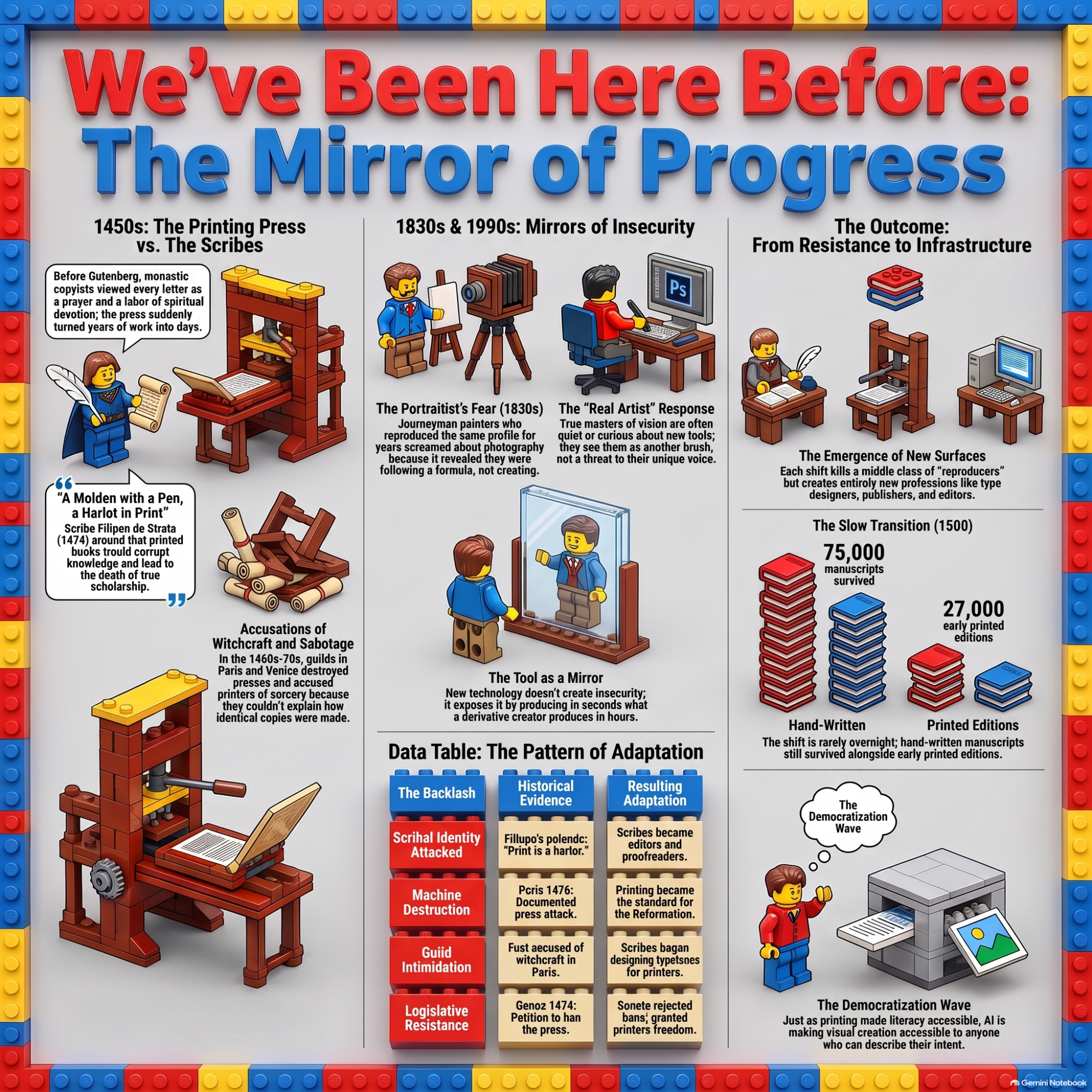
- The Scribe’s Polemic: Resistance to the Printing Press
The introduction of the Gutenberg press triggered a backlash that mirrors the modern vitriol against mechanical apprentices. Filippo de Strata, a Benedictine monk and scribe, authored a formal polemic to the Doge of Venice, arguing that printed books were “worthless” and “vile.” He famously characterized the transition with the emotional dagger: “A maiden with a pen, a harlot in print.” The Doge, notably, ignored the petition, recognizing the tide of democratization.
The resistance was grounded in a fear of losing an exclusive craft. In 1474, the Genoa Scribes’ Petition argued that printers employed “uneducated people,” suggesting that the new technology produced mere “slop” that had no place in society. The arguments included:
- The Accusation of Sorcery: In Paris, the Scribes’ Guild accused Johann Fust (Gutenberg’s financier) of witchcraft because they could not believe identical copies could be produced without sorcery. Fust was chased out of town.
- Mechanical Vandalism: In 1476, scribes in Paris attacked and destroyed a printing press set up by Johann Heynlin.
- The “Soul” Argument: Critics claimed machine-produced text lacked the spiritual dedication of hand-copied manuscripts, fearing cheap books would fill minds with “garbage.”
- The Photography Crisis and the Death of the Journeyman
The 19th-century arrival of photography did not kill “Art,” but it “vaporized” the middle tier of commercial work. Before the camera, journeyman painters survived on “bread and butter” commissions: portrait miniatures, landscapes, and genre scenes of daily life. These were formulaic reproductions that satisfied a market need.
The arrival of the chemical box exposed the distinction between the “Master” and the “Journeyman”:
- The Master: Used the camera as a “new surface” to expand their vision and focus on the act of “seeing.”
- The Journeyman: Relied on reproducing established formulas for a living.
The vitriol directed toward photography was an existential response to a threat to meaning. The journeymen’s “hands knew that work,” and their entire framework of identity was tied to a manual process that was suddenly being automated. The energy spent on outrage was a direct result of the mirror photography held up: it revealed that their work was derivative. The journeyman portraitist who painted the same profile for fifteen years hated the camera because it proved their value was in the labor, not the vision.
- Conclusion: The New Surface
History reveals a consistent, rhythmic pattern: New tools democratize creation, squeeze the “journeyman” class, and are eventually absorbed as “invisible” infrastructure. We are currently witnessing the rise of “Mechanical Apprentices” and “Pattern Recognition Engines” the latest evolution in the workshop lineage.
The scale of the past was invisible because it was diffuse; the scale of our new tools is visible because it is concentrated. We see the meter running on the energy of a data center, but we forget the thousands of calves slaughtered for a single library. This “new surface” is viewed as a crisis only by those whose identity is tied to the manual execution of the previous era.
Ultimately, the value of an artist has never resided in the labor of execution, which is always eventually automated, but in the “seeing,” the “choosing,” and the “intent.” The vitriol we hear today is the sound of someone not wanting to ask the question of their own value. The technology will eventually become invisible, leaving only the artist’s vision as the metric of worth. The master does not fear the apprentice; the master uses the apprentice to see further.